Youth Justice
Young people who become involved in the justice system are deserving of support, rehabilitation, and safety. For too long, Maryland has focused on punitive punishment after the fact rather than services and support that prevent justice involvement for children. Black youth in particular are charged as adults in this state at alarming rates. And, relatedly, the public conversation around young people is dominated by fear, rather than data, research, or understanding of the root causes of crime.
Advance Maryland Education Fund serves as an anchor organization in the movement for youth justice in Maryland alongside dozens of partners from across the state. We strive to center youth, youth-led organizations, and youth-serving organizations, while working alongside policy experts and advocates. We provide the staffing, infrastructure, strategy, outreach, and communications support that allows the movement to grow.
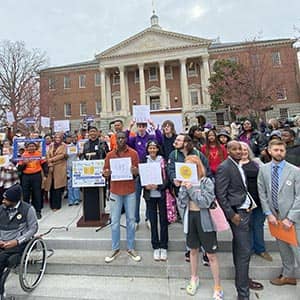
Through the Maryland Youth Justice Coalition (MYJC), AMDEF serves as the backbone for a statewide coalition advancing policy change that keeps young people out of the adult legal system. For fourteen years, MYJC has organized for a Maryland where no child is at risk of system involvement, and those who do come into contact with the legal system are met with care, not punishment.
In May 2026, Governor Moore signed the Youth Charging Reform Act — the result of more than a decade of coalition advocacy. The new law makes modest, targeted changes to Maryland’s automatic charging practices, beginning to unwind a system that funnels 16- and 17-year-olds into adult court. Roughly half of the cases that would have started in adult court will now begin in the youth justice system, protecting about 500 young people every year. We regard this as the first step in ending the practice of automatic charging children as adults altogether.
Looking ahead, MYJC is focused on defending the new law, expanding its network across the state, and ensuring Maryland funds the prevention and community-based programs that keep young people from becoming system-involved in the first place. Most importantly, the coalition is working directly with young people to understand their priorities and reflect them in the work ahead.
Long-term change also requires shifting the narrative. Through the Youth Rights and Safety Hub (YRSH), a project launched by AMDEF in 2025, we work to reshape how Marylanders talk about, and understand young people and safety. Conversations about safety too often place disproportionate responsibility on young people while overlooking their needs and their right to safety. YRSH partners with community members, policy experts, and communications professionals to share the truth, not the hype, about what Maryland’s kids are experiencing and what they need to thrive.
YRSH convenes a hub space with youth members, youth-serving organizations, and other key stakeholders, and sends a monthly newsletter to decisionmakers across the state. We publish a regular analysis of how media covers youth in Maryland that reaches key decision makers across our state, and we write essays and feature guest writing from young people and partners on the YRSH Substack.
In 2025, as part of YRSH, we launched We Are BMore — a campaign built to challenge the dominant narrative that reduces Baltimore’s young people to a single, harmful stereotype. The work began with what mattered most: listening.
Young people led every part of the project. Through multiple listening sessions, youth interviewed their peers to understand two things at once: how Baltimore’s young people feel about the public perceptions of them, and how they view themselves. From those conversations came the campaign’s messages written by youth, for youth, and for the broader public. The visual art and design were also youth-led.
We Are BMore is a reminder that Baltimore’s kids are artists and athletes, dancers and dreamers, musicians, inventors, problem-solvers, comedians, and far more than the headlines suggest.
This is movement work, and it requires sustained commitment. We will continue to serve as anchor, backbone infrastructure, and convenor in this movement alongside the partners and campaigns that are moving Maryland closer to a youth justice system rooted in care, dignity, and the voices of young people themselves.